
Staking now
ETH deposited since 2020
92,748,888
the deposit contract's balance; it only rises
Validator keys funded
2,409,468
every key that has received a deposit since 2020
Stake in compounding validators
41.96%
held by 2.93% of active validators
Average effective balance
53.51 ETH
per active validator; 32 ETH before Pectra
- 92,748,888 ETH has been sent to the staking deposit contract since it opened in November 2020 (today so far, data through 15:00 UTC). That is not the amount staked now: withdrawals are paid by the protocol, not out of the contract, so its balance counts every ETH ever deposited.
- Since the Pectra upgrade a compounding (0x02) validator can hold up to 2,048 ETH. Compounding validators hold 41.96% of the active stake while making up 2.93% of active validators (today so far, data through 15:00 UTC).
In more detail Plus
- Active Validators: the number of validators taking part in consensus.
- Total Effective Balance: the active stake in ETH: the effective balance of every active validator.
- Validators by Status: every validator by status, from pending activation to withdrawn.
Entry and exit queues
Entry queue
1,258,703 ETH
16,412 deposits: 15,371 new validators and 1,001 top-ups
Wait to enter
22.3 days
a deposit made now is credited around 17 Nov 2026
Exit queue
64 ETH
2 validators waiting to leave
Wait to exit
31 minutes
then 27.3 hours until the balance can be withdrawn
- The protocol credits queued deposits in order at each epoch boundary (every 6.4 minutes), up to the churn limit of 256 ETH per epoch (57,600 ETH a day), the most it allows at today's stake, and at most 16 deposits per epoch. Applied to today's queue deposit by deposit, that rule credits a 32 ETH deposit made now at the end of epoch 489,935, around 17 Nov 2026, 23:50 UTC: 22.3 days. The queue divided by the churn limit gives 21.9 days.
- A new validator becomes eligible at the next epoch and is activated once that epoch is finalized: it starts validating about 45 minutes after its deposit is credited.
- An exit leaves the active set at the exit epoch the protocol assigns: the end of today's exit queue or five epochs after the request, whichever is later, so a new exit would leave around 26 Oct 2026, 16:16 UTC. Its balance is then held for 27.3 hours (256 epochs) before it can be withdrawn; the withdrawal sweep, which pays validators in turn by index, then pays it on its next pass; its last complete pass took 7.3 days, from 13 Oct 2026, 11:06 UTC to 20 Oct 2026, 17:25 UTC.
- 15,371 new validators are waiting to be credited with 1,072,837 ETH; the other 1,001 deposits top up 185,866 ETH to validators that exist already.
Other queues
| Queue | Waiting | Wait now |
|---|---|---|
| Consolidations | 235,574 ETH 2,707 validators | about 2.5 days |
| Requested partial withdrawals | 3,509 ETH 354 requests | about 27.8 hours |
- A validator merging into another (a consolidation) waits in its own queue, under the part of the churn limit that deposits and exits do not use, and its balance moves 27.3 hours after it leaves. A partial withdrawal requested from the execution layer takes its turn in the exit queue and is paid 27.3 hours after that turn.
Queue history
Entry waitExit wait
Longest waits in our record
| Queue | Longest wait | Day |
|---|---|---|
| Entry wait | 71.5 days | 11 Feb 2026 |
| Exit wait | 46.4 days | 12 Sep 2025 |
The queues at the close of the day
| Day | Entry queue (ETH) | Entry wait (days) | Exit queue (ETH) | Exit wait (days) |
|---|---|---|---|---|
| Latest closed day 25 Oct 2026 | 1,272,359 | 22.1 | 96 | 0.0 |
| A week earlier 18 Oct 2026 | 1,226,145 | 21.3 | 229,787 | 4.0 |
| A month earlier 25 Sep 2026 | 1,676,813 | 29.1 | 32 | 0.0 |
| A year earlier 25 Oct 2025 | 1,269,293 | 22.0 | 2,459,426 | 42.7 |
- On 22 of the last 30 closed days both queues held at least a day's churn. On such days about as much stake leaves the active set as joins it, because deposits and exits each run at the same limit, so the active stake changes little until one of the queues runs dry.
In more detail Plus
- Churn Limit Use: how much of each epoch's churn limit entries, exits and consolidations use.
By organisation Pro
- Entry Queue by Organisation: the entry queue split by staking organisation.
- Exit Queue by Organisation: the exit queue split by staking organisation.
Deposits and withdrawals
Deposited today
22,366 ETH
today so far, data through 15:00 UTC
Principal withdrawn today
32,117 ETH
exits and requested withdrawals
Net flow today
−9,751 ETH
deposits minus principal withdrawn
New validators funded today
176
keys receiving their first deposit
Into and out of staking
| Period | Deposited (ETH) | Principal withdrawn (ETH) | Net (ETH) |
|---|---|---|---|
| Last 7 days 19 Oct 2026 to 25 Oct 2026 | 452,258 | 409,671 | +42,587 |
| Last 30 days 26 Sep 2026 to 25 Oct 2026 | 1,348,120 | 1,370,237 | −22,116 |
| Since the Pectra upgrade 7 May 2025 to 25 Oct 2026 | 31,736,146 | 20,486,818 | +11,249,328 |
The last 14 closed days
| Day | Deposited (ETH) | New validators | Principal withdrawn (ETH) | Net (ETH) |
|---|---|---|---|---|
| 25 Oct 2026 | 12,142 | 129 | 52,087 | −39,945 |
| 24 Oct 2026 | 14,677 | 127 | 86,240 | −71,563 |
| 23 Oct 2026 | 24,588 | 171 | 37,484 | −12,896 |
| 22 Oct 2026 | 93,854 | 1,872 | 29,228 | +64,627 |
| 21 Oct 2026 | 79,580 | 1,717 | 39,095 | +40,485 |
| 20 Oct 2026 | 217,060 | 1,120 | 80,885 | +136,175 |
| 19 Oct 2026 | 10,356 | 180 | 84,653 | −74,297 |
| 18 Oct 2026 | 6,008 | 75 | 31,761 | −25,754 |
| 17 Oct 2026 | 41,310 | 523 | 111,245 | −69,935 |
| 16 Oct 2026 | 51,767 | 958 | 47,590 | +4,178 |
| 15 Oct 2026 | 72,566 | 1,258 | 59,198 | +13,368 |
| 14 Oct 2026 | 109,577 | 2,749 | 140,065 | −30,488 |
| 13 Oct 2026 | 32,382 | 349 | 43,433 | −11,052 |
| 12 Oct 2026 | 15,337 | 103 | 88,339 | −73,002 |
- Deposits are every deposit request in the day's blocks, for new validators and top-ups. Principal withdrawn is the full balance paid to exited validators plus partial withdrawals their owners requested from the execution layer. The automatic payout of rewards above a validator's effective cap is income, not unstaking, so it is left out.
In more detail Plus
- Staking Deposits by Type: deposits split into new validators and top-ups.
- Staking Withdrawals by Type: exits, automatic reward payouts and requested withdrawals.
By organisation Pro
- Staking Deposits by Organisation: deposits by staking organisation.
- Staking Withdrawals by Organisation: withdrawals by staking organisation.
Staking yield
Validators earn in two ways. Consensus-layer rewards are new ETH the protocol issues for attesting, proposing blocks and sync-committee duty, net of penalties; the protocol pays less per ETH as the total stake grows, in proportion to one over its square root. Execution-layer rewards come from users and block builders: the priority fees of the transactions in a proposer's block, or the payment a builder makes for the right to build it through MEV-Boost.
Our Staking APR chart measures both from our own nodes: each day's consensus-layer rewards (the change in the consensus layer's ledger less deposits plus withdrawals, exact from the day-end state) and every block's execution-layer reward, divided by the active stake and annualised. It is the network-wide rate before any staking service's fee; a single validator earns more or less with its proposals and uptime. Its current reading and history come with a Plus plan.
Builder payments, last 7 days
525 ETH
to block proposers, 19 Oct 2026 to 25 Oct 2026
Median builder payment per block
0.00481 ETH
25 Oct 2026
Blocks built by builders
89.9%
through MEV-Boost, 25 Oct 2026
In more detail Plus
- Staking APR: consensus and execution-layer rewards over the active stake, each day, annualised.
- Staking Rewards: the ETH validators earn each day, by layer.
- Execution-Layer Rewards to Proposers: priority fees and builder payments to block proposers.
- Open Staking Rate: the yield of each withdrawal credential type.
By organisation Pro
- Staking Yield by Organisation: the yield of each staking organisation.
Who stakes
We name an organisation only where a registry it runs on chain proves its validators, read from our own execution node: today the staking protocols Ankr, ether.fi, Frax Ether, Kelp, Lido, Liquid Collective, Mantle mETH, Puffer, Renzo, Rocket Pool, Stader, StakeWise and Swell, plus validators natively restaked in other owners' EigenLayer EigenPods, which belong to many operators. Exchanges and custodians publish no such registry, so their validators are not attributed: they count with solo stakers as unattributed. No individual validator or depositor is named.
Staking Concentration Index
489
today so far, data through 15:00 UTC; 0 to 10,000
- The index adds up the squared shares of the active stake each organisation holds. Competition authorities read values below 1,500 as unconcentrated, 1,500 to 2,500 as moderately and above 2,500 as highly concentrated; today's 489 reads as unconcentrated, against 479 a month earlier (26 Sep 2026).
- Unattributed stake is treated as held by many small holders, so the true concentration is at least this high. Open the Staking Concentration Index chart.
Stake by organisation Plus
- Staked ETH by Organisation: the active stake of each organisation.
- Share of Staked ETH by Organisation: each organisation's share of the active stake.
- Stake Share of the Largest Organisations: the share held by the largest one, three and five.
- Staked ETH by Entity Type (Estimated): liquid staking, restaking and the rest.
Per-organisation detail Pro
- Active Validators by Organisation: the active validators of each organisation.
- Lido Stake by Node Operator: Lido's stake by node operator.
How these figures are made
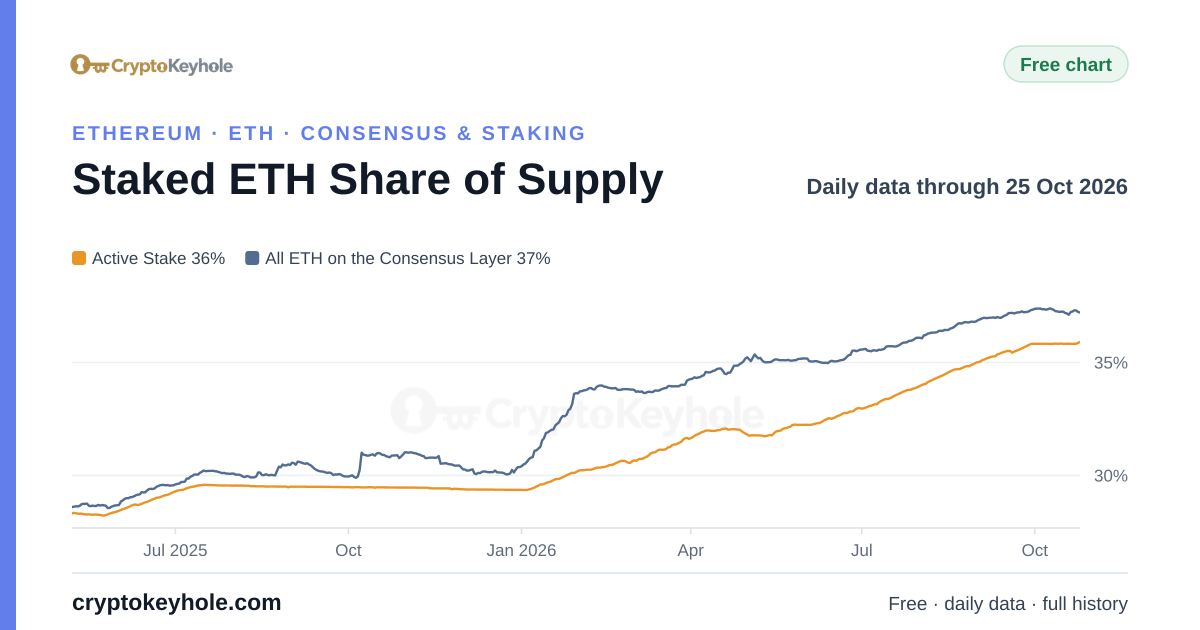
Share staked. The effective balance of active validators as a share of the whole ETH supply (ETH held by execution-layer accounts plus the consensus layer's ledger), from our Staked ETH Share of Supply chart. Our consensus node applies every block since the Pectra upgrade (7 May 2025) with the consensus client's own state transition code, and each hour's state is accepted only when it matches the state root our node's blocks commit to. The second figure also counts balances above the effective cap, validators waiting to enter or leave and deposits in the queue. Only finalized blocks are used; the open day is a labelled partial, updated every hour.
Queues now. Every five minutes we read one state from our own consensus node, the latest finalized one: its deposit queue, the validators whose exit has started, the pending consolidations and the partial withdrawals requested from the execution layer. A validator merging into another waits in the consolidation queue, not the exit queue. The churn limit follows the protocol's Electra rules with the constants of our node's own configuration: the total active stake divided by 65,536, at least 128 ETH and, for deposits and exits, at most 256 ETH per epoch; consolidations get the rest.
Waits. For a new deposit we run the protocol's deposit processing on today's queue, epoch by epoch: deposits are credited in order while the churn limit covers them, at most 16 per epoch; a deposit to a validator that is exiting moves to the back, and one to a withdrawn validator is credited without using the churn. The state's small carry of unused churn is not published by the node, so the date can be one epoch early. For a new exit or consolidation, the protocol gives the later of the end of its queue and five epochs after the request. Waits assume the queues ahead do not change; deposits and exits made later do not delay an earlier one.
Flows and history. From our Net Staking Flow, Validator Entry and Exit Queues and Validator Queue Wait Time charts: deposit requests and withdrawals as paid in each day's blocks, and each day's closing queues. Before Pectra the entry queue counts validators waiting for activation at 32 ETH each.
Who stakes. Organisations are named only from registries they run themselves on chain; no exchange, custodian or third-party labels are used. Builder payments come from the blocks our execution node holds, matched to the delivery records relays publish.
Questions
What share of ETH is staked?
How long is the Ethereum validator queue?
How long does it take to unstake ETH?
What is the churn limit?
How much stake can enter or leave the active validator set per epoch (6.4 minutes). Since the Pectra upgrade it is set in ETH: the total active stake divided by 65,536, at least 128 ETH, and at most 256 ETH per epoch (57,600 ETH a day) for deposits and exits; consolidations get the rest. Before Pectra it was counted in validators.
What is the ETH staking APR?
The yearly rate validators earn on their stake: consensus-layer rewards issued by the protocol plus execution-layer rewards from priority fees and builder payments, before any staking service's fee. Our Staking APR chart measures it every day from our own nodes, on the Plus plan.
Is ETH staked through exchanges counted?
Yes. Every active validator counts in the share staked, the queues and the flows. Exchanges are not named as stakers because they publish no on-chain registry of their validators; only staking protocols that run one are.
Open the staking share chartStaking dashboardAll free tools
Figures on this page are read by CryptoKeyhole from our own Ethereum consensus and execution nodes and refreshed automatically; waits say how they are worked out. Nothing here is investment advice.