
Sources and method
Every figure comes from the companies' own filings with the US Securities and Exchange Commission, read from EDGAR: their 10-K annual and 10-Q quarterly reports, with amendments; announcements in 8-K filings and press releases are not read. We check every covered company for new filings twice an hour.
A holding is the number of ether a filing says the company held on a date, taken from the report's tagged financial data (XBRL) or from its own sentences. We accept a figure when that number of coins, valued at our own ETH/USD price for the date, agrees with the fair value the same filing reports for its ether (within 8%, allowing for the filing's rounding). Where a filing reports no fair value, we use the number its text states or, for a few companies whose tagging we have checked, the tagged number. For a date covered by more than one filing, the latest filing decides. Every figure keeps its SEC accession number, and each row links to the document that states it.
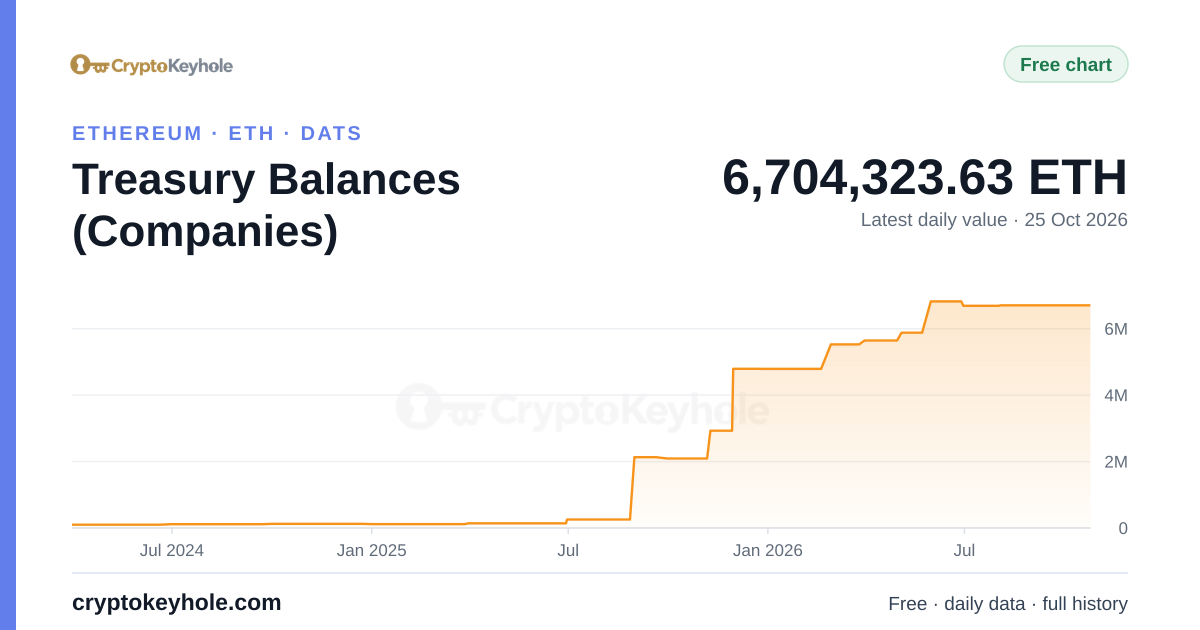
The table shows each company's latest accepted figure. Holdings as of is the date that figure refers to: the end of the quarter or year a 10-Q or 10-K reports, or a later date the report gives. Change since previous filing is that figure less the company's latest figure in its previous filing, whose date is shown. Value at today's price multiplies the coins by our ETH/USD index price for the latest complete hour, and share of supply divides them by all ether in existence, counted by our own Ethereum nodes; neither is a figure the companies report.
The page is recalculated as soon as the ledger reads a new filing, and every ten minutes for the price. The figures on this page are free to reuse under the Creative Commons Attribution 4.0 licence (CC BY 4.0): credit CryptoKeyhole with a link to this page.
Coverage and limits
- Who is covered. Companies that file 10-K and 10-Q reports with the US SEC and state a number of ether held for their own account, found through the crypto-asset values tagged in their filings: 17 today.
- Who is not. Companies that report only to regulators outside the US, for example companies listed only in Tokyo, London, Paris, Stockholm, Toronto or Hong Kong; foreign companies that file with the SEC only on Forms 20-F, 40-F and 6-K; private companies; governments; and funds and ETFs (the US spot ether ETFs are on our Ethereum ETF flows page). Coins a company holds for its customers are not counted.
- Filing lags. Holdings are as of each figure's date, not live. Companies file a 10-Q within 40 or 45 days of a quarter's end and a 10-K within 60 to 90 days of the year's end, so coins bought or sold since the date shown appear only with the next filing. Weekly announcements and press releases are not read, so a company that reports purchases every week shows its latest report's figure.
- As stated. Each figure is the number the filing gives. Companies count differently: coins lent out, pledged as collateral or held through a fund or a subsidiary can be inside or outside a company's figure, and we do not adjust it. Ether a company has staked counts where its filing counts it in ETH; liquid-staking and restaking tokens count only where the filing's own ETH figure includes them. The notes under the table name the cases that move a figure most.
- Counted once. A company whose coins sit inside another filer's consolidated figure is named under the table and not added again; an acquired company's coins count in its acquirer's figure from the acquirer's first report after the deal; a company that files no new figure for 400 days leaves the total.
- Newer reports. Where a company has filed a later 10-Q or 10-K stating no number of ether we could confirm, its row keeps the last confirmed figure and the notes say so.
Questions
How much ether do public companies hold?
Which company holds the most ether?
Are these holdings live?
No. Each figure is what a company's latest SEC filing states for a given date, usually the end of a quarter, and quarterly reports arrive up to 45 days after it. Weekly announcements are not read, so a company's purchases and sales show only with its next report.
Does staked ether count?
Ether a company has staked counts where its filing counts it in ETH. Liquid-staking and restaking tokens count only where the filing's own ETH figure includes them; the notes under the table name the companies where this changes the figure most.
Which companies are not included?
Companies that do not file 10-K and 10-Q reports with the US SEC: those reporting only to regulators elsewhere, foreign companies that file on Forms 20-F or 40-F, private companies and governments. Spot ether ETFs and other funds are on our Ethereum ETF flows page. Coins held for customers are not counted.
Can I use this data?
Yes. The figures on this page are licensed under Creative Commons Attribution 4.0 (CC BY 4.0): reuse them with credit to CryptoKeyhole and a link to this page. Data from paid plans is not covered.
Open the treasury balance chartAll free tools
Holdings are as the companies state them in their filings with the US SEC, read by CryptoKeyhole; values use our ETH/USD index price and shares of supply all ether in existence, counted by our own Ethereum nodes. Nothing here is investment advice.