
Supply now
Issued so far (BTC)
20,103,883.54
at block 973,251
Share of 21 million
95.73%
of the 21,000,000 BTC cap
Still to be mined (BTC)
896,087.48
by the issuance schedule
New coins per block (BTC)
3.125
about 450 BTC a day at 144 blocks
95.73% of the 21 million cap issued: 20,103,883.54 of 21,000,000 BTC
- Exactly 20,103,883.54155096 BTC had been issued by block 973,251, mined 26 Oct 2026, 15:04 UTC: every coin miners have claimed since the genesis block, the genesis block's 50 BTC included.
- That is a little below what the schedule allows by now, because a few blocks over the years claimed less than their subsidy; those coins were never created and cannot be later.
- Still to be mined: 896,087.4769 BTC, the subsidies of every block after 973,251 until the last one, if each claims its full subsidy.
The issuance schedule
New bitcoins enter circulation only as the subsidy in each block's coinbase transaction. It started at 50 BTC and halves every 210,000 blocks, about every four years, so issuance slows in steps towards a fixed total. Every number in this table follows from that rule.
| Era | Blocks | New coins per block | Issued in the era | Total by its end | Began |
|---|---|---|---|---|---|
| 1 | 0 – 209,999 | 50 | 10,500,000 | 10,500,000 | 3 Jan 2009 genesis block |
| 2 | 210,000 – 419,999 | 25 | 5,250,000 | 15,750,000 | 28 Nov 2012 |
| 3 | 420,000 – 629,999 | 12.5 | 2,625,000 | 18,375,000 | 9 Jul 2016 |
| 4 | 630,000 – 839,999 | 6.25 | 1,312,500 | 19,687,500 | 11 May 2020 |
| 5 now | 840,000 – 1,049,999 | 3.125 | 656,250 | 20,343,750 | 20 Apr 2024 |
| 6 | 1,050,000 – 1,259,999 | 1.5625 | 328,125 | 20,671,875 | around 9 Mar 2028 estimate |
| 7 | 1,260,000 – 1,469,999 | 0.78125 | 164,062.5 | 20,835,937.5 | around 2032 |
| 8 | 1,470,000 – 1,679,999 | 0.390625 | 82,031.25 | 20,917,968.75 | around 2036 |
Eras 9 to 34
| Era | Blocks | New coins per block | Issued in the era | Total by its end | Began |
|---|---|---|---|---|---|
| 9 | 1,680,000 – 1,889,999 | 0.1953125 | 41,015.625 | 20,958,984.375 | around 2040 |
| 10 | 1,890,000 – 2,099,999 | 0.09765625 | 20,507.8125 | 20,979,492.1875 | around 2044 |
| 11 | 2,100,000 – 2,309,999 | 0.04882812 | 10,253.9052 | 20,989,746.0927 | around 2048 |
| 12 | 2,310,000 – 2,519,999 | 0.02441406 | 5,126.9526 | 20,994,873.0453 | around 2052 |
| 13 | 2,520,000 – 2,729,999 | 0.01220703 | 2,563.4763 | 20,997,436.5216 | around 2056 |
| 14 | 2,730,000 – 2,939,999 | 0.00610351 | 1,281.7371 | 20,998,718.2587 | around 2060 |
| 15 | 2,940,000 – 3,149,999 | 0.00305175 | 640.8675 | 20,999,359.1262 | around 2064 |
| 16 | 3,150,000 – 3,359,999 | 0.00152587 | 320.4327 | 20,999,679.5589 | around 2068 |
| 17 | 3,360,000 – 3,569,999 | 0.00076293 | 160.2153 | 20,999,839.7742 | around 2072 |
| 18 | 3,570,000 – 3,779,999 | 0.00038146 | 80.1066 | 20,999,919.8808 | around 2076 |
| 19 | 3,780,000 – 3,989,999 | 0.00019073 | 40.0533 | 20,999,959.9341 | around 2080 |
| 20 | 3,990,000 – 4,199,999 | 0.00009536 | 20.0256 | 20,999,979.9597 | around 2084 |
| 21 | 4,200,000 – 4,409,999 | 0.00004768 | 10.0128 | 20,999,989.9725 | around 2088 |
| 22 | 4,410,000 – 4,619,999 | 0.00002384 | 5.0064 | 20,999,994.9789 | around 2092 |
| 23 | 4,620,000 – 4,829,999 | 0.00001192 | 2.5032 | 20,999,997.4821 | around 2096 |
| 24 | 4,830,000 – 5,039,999 | 0.00000596 | 1.2516 | 20,999,998.7337 | around 2100 |
| 25 | 5,040,000 – 5,249,999 | 0.00000298 | 0.6258 | 20,999,999.3595 | around 2104 |
| 26 | 5,250,000 – 5,459,999 | 0.00000149 | 0.3129 | 20,999,999.6724 | around 2108 |
| 27 | 5,460,000 – 5,669,999 | 0.00000074 | 0.1554 | 20,999,999.8278 | around 2112 |
| 28 | 5,670,000 – 5,879,999 | 0.00000037 | 0.0777 | 20,999,999.9055 | around 2116 |
| 29 | 5,880,000 – 6,089,999 | 0.00000018 | 0.0378 | 20,999,999.9433 | around 2120 |
| 30 | 6,090,000 – 6,299,999 | 0.00000009 | 0.0189 | 20,999,999.9622 | around 2124 |
| 31 | 6,300,000 – 6,509,999 | 0.00000004 | 0.0084 | 20,999,999.9706 | around 2128 |
| 32 | 6,510,000 – 6,719,999 | 0.00000002 | 0.0042 | 20,999,999.9748 | around 2132 |
| 33 | 6,720,000 – 6,929,999 | 0.00000001 | 0.0021 | 20,999,999.9769 | around 2136 |
| 34 | 6,930,000 onward | 0 | 0 | 20,999,999.9769 | around 2140 |
Totals are what the schedule allows; coins issued so far are slightly fewer (see above). Past dates are our node's block times. The next halving's date is estimated at the average block time of the last 2,016 blocks; later dates assume exactly ten minutes per block and are only indicative.
The next halving
- At block 1,050,000 the subsidy halves from 3.125 to 1.5625 BTC per block, and new coins fall from about 450 to about 225 BTC a day.
- 76,749 blocks to go: at the average pace of the last 2,016 blocks (9.39 min per block) that is around 9 March 2028; at the fastest and slowest pace of the last 26 difficulty epochs, between 3 Feb 2028 and 17 Jun 2028.
- By then the schedule will have issued 20,343,750 BTC, 96.88% of 21 million.
- The halving countdown follows it block by block, with every past halving and the price at the time.
The last bitcoin
- Each halving drops the last binary digit of the subsidy in satoshis, so it reaches a single satoshi in the 33rd era (blocks 6,720,000 to 6,929,999) and zero at block 6,930,000.
- Block 6,929,999 pays the last new satoshi. At ten minutes per block from block 973,251 that is around 2140; the real date depends on how fast blocks arrive over the next century.
- The schedule then totals 20,999,999.9769 BTC: rounding the subsidy down to a whole satoshi at each halving leaves it 0.0231 BTC short of 21 million.
- After that, miners are paid by transaction fees alone.
Coins unmoved for a year or more
- 63.7% of the spendable supply last moved more than a year ago (today so far, 26 Oct 2026), from our Supply Last Active 1+ Years Ago chart.
- Unmoved is not lost. Long-term holders, custodians and exchanges keep coins still for years, and the chain cannot tell a lost key from a patient holder, so we publish no estimate of lost coins.
- A few coins can never move under the protocol's own rules: the genesis block's 50 BTC, and 100 BTC from two coinbase transactions of 2010 that were duplicated and overwritten.
- Dormant bitcoin on the move lists every transaction that spends coins unmoved for seven years or more.
Unmoved for longer Plus
- Supply last active 5 or more years ago: how much has not moved for five years
- Supply last active more than 10 years ago: coins untouched for a decade or more
Coins held by exchanges, ETFs and companies
- 1,127,940 BTC in the wallets of the exchanges we label (today so far, 26 Oct 2026). Rising over 30 days (+13,069 BTC since 26 Sep 2026): more BTC arrived at the exchange wallets we label than left. Counted from our own node: the reserve addresses each exchange published, and addresses our clustering ties to them (Exchange Balance chart; its full daily history is free with an account).
- 1,080,707 BTC held by the US spot bitcoin ETFs whose issuers publish daily holdings files, on 22 October 2026: 5.38% of the bitcoin supply (US Spot ETF Total Holdings; daily flows on the ETF flows page).
- 1,119,691 BTC held by public companies that file with the US SEC, as their latest filings report it on 26 Oct 2026, 5.57% of the coins issued (Treasury Balances (Companies)).
Each group is counted from its own source and they can overlap: an exchange or custodian can hold coins for a fund or a company. Their sum is not a total of coins in custody. Exchanges are those we label; ETFs are those whose issuers publish daily files; companies are those that report holdings to the US SEC.
Supply since 2009
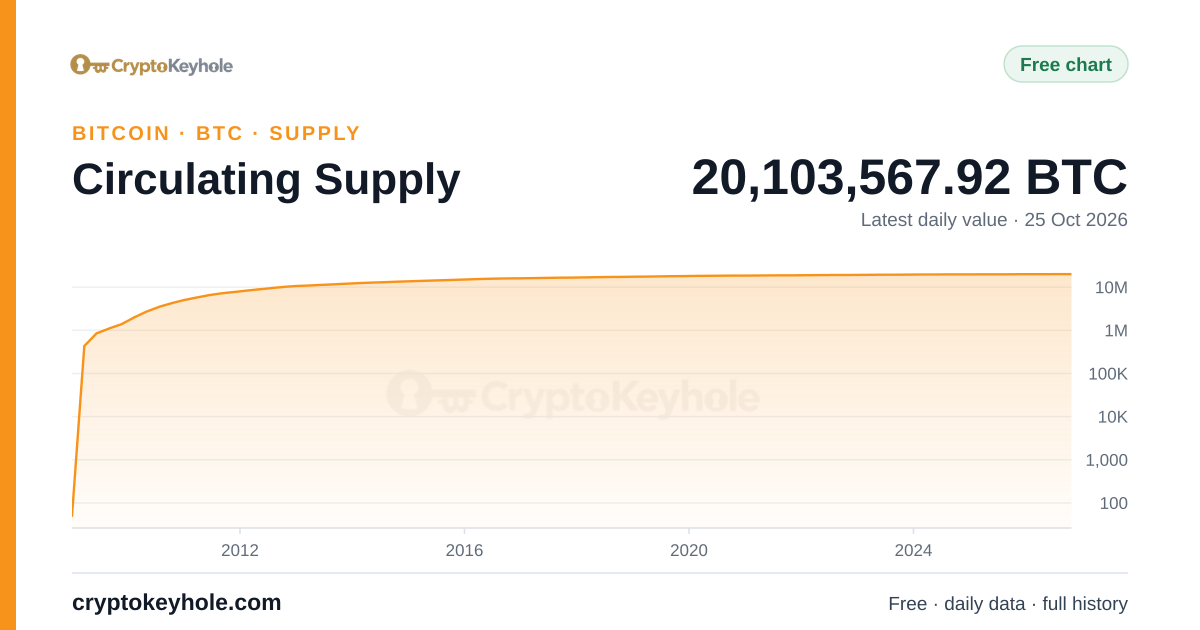
BTC issued
How the count is made
Issued so far counts every coin miners have claimed: each block's coinbase outputs minus the fees the block collected, from the genesis block on. It is the figure of our Circulating Supply chart, which our upkeep writes from our own validated Bitcoin Core node. This page takes that chart's newest value, at the block it reached, and adds every later block from our node in whole satoshis, so it is exact at the latest block.
It includes the genesis block's 50 BTC and any coins lost since, so it is not the spendable supply. It is a little below what the schedule allows, because a few blocks over the years claimed less than their subsidy. The share of 21 million divides it by 21,000,000 BTC. Still to be mined is the schedule's future subsidies: the 20,999,999.9769 BTC the schedule ends at, minus what it allows through the latest block.
The chart's open day is a labelled partial and becomes final once the day has six confirmations. Just after a block is found, a competing block can replace it; the page follows our node's best chain at every block. The dormancy and custody readings carry their own dates and sources.
Questions
How many bitcoins are there?
How many bitcoins are left to mine?
When will the last bitcoin be mined?
Block 6,929,999 is the last with a subsidy, of one satoshi; from block 6,930,000 the subsidy is zero. At ten minutes per block that falls around the year 2140, but the date depends on how quickly blocks arrive over the next century.
Why will there never be exactly 21 million bitcoins?
The subsidy started at 50 BTC and halves every 210,000 blocks, rounded down to a whole satoshi each time. The rounding trims a little from each era, so the schedule ends at 20,999,999.9769 BTC. A few blocks also claimed less than they were allowed, and those coins can never be created later.
How many bitcoins are lost?
Nobody can say. A coin whose key is lost looks exactly like a coin in long-term storage, so the chain cannot tell them apart. We publish measured dormancy instead: how much of the supply has not moved for a year or more. Only a few amounts are provably unspendable, such as the genesis block's 50 BTC.
What happens after the last bitcoin is mined?
The supply stops growing and miners are paid by transaction fees alone. Nothing else in the protocol changes.
Open the supply chartHalving countdownCreate free accountAll free tools
Figures on this page are calculated by CryptoKeyhole from our own Bitcoin node and the price data we collect, and refreshed automatically; estimates say how they are made. Nothing here is investment advice.