
Ask about this page
Our AI analyst answers questions about this page from CryptoKeyhole’s own data and charts. Free with an account.
Asking opens a free account in a few seconds (a username and a password, no email); then the answer appears here.
Who is trading aggressively
In the last hour, aggressive buyers of BTC perpetuals on Binance and OKX outbought aggressive sellers: a taker buy/sell ratio of 1.24. The account ratio counts who holds positions; the taker ratio counts who is pushing the price right now, buying at the offer or selling at the bid. Above 1 buyers are in a hurry, below 1 sellers.
What the ratio counts
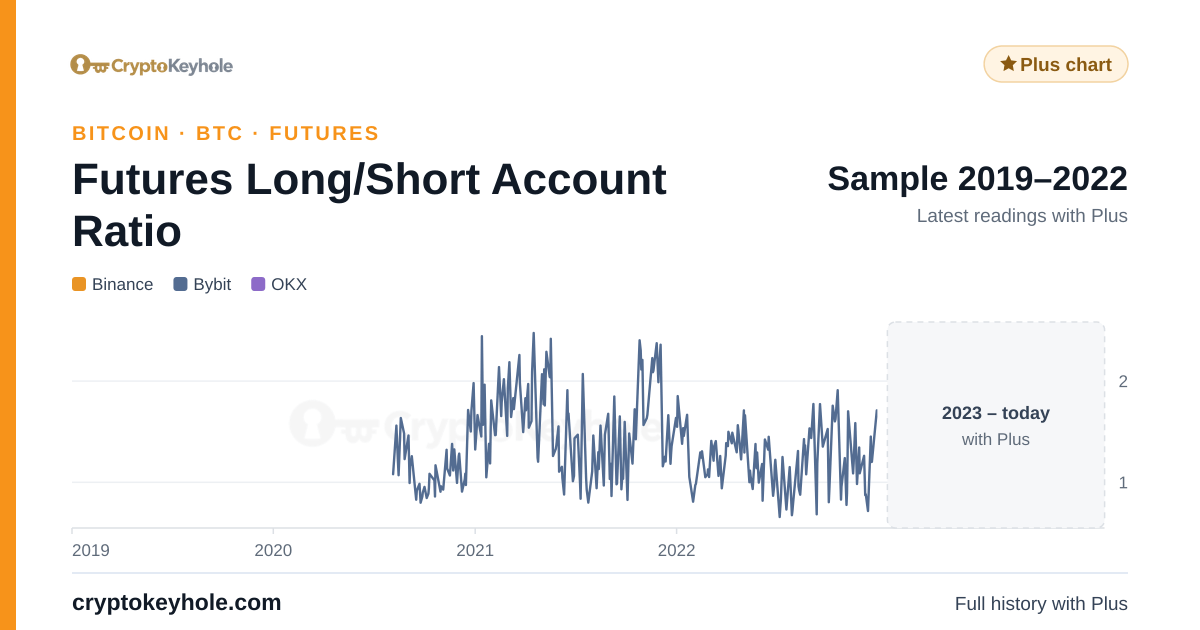
Each exchange publishes, every five minutes, how many of its accounts hold a net long position in a contract and how many a net short one. Every account counts once, whatever its size, so the ratio measures the crowd, not the money: three small accounts long and one large account short read as 3.00 even if the short is the bigger bet. Open interest is always equal on both sides (every long has a short on the other side of the trade), so the ratio says how the positions are spread across traders, not that more bitcoin is held long.
That is why the top-trader figures matter. Binance publishes the same split for its largest accounts (the top 20% of its users by margin balance) twice: by headcount and weighted by position size. When the crowd and the largest positions lean apart, the larger side by size usually decides the move.
Readings far from a venue's usual range mark a crowded side. Crowded longs are what a sharp fall liquidates, and crowded shorts what a squeeze forces to buy back, so the ratio is read against the trend: very high readings into a rally are a warning more often than a signal to follow.
Method and sources
Each venue's own published long/short account ratio for its BTC perpetuals, read by CryptoKeyhole every five minutes: Binance and Bybit for their BTCUSDT perpetual, OKX across all its BTC contracts. The headline is the average of the venues present, as on our Long/Short Account Ratio chart; the share of accounts long is each venue's published share (OKX's from its ratio). Binance's top-trader ratios and its taker volumes are its published figures for BTCUSDT, and OKX's taker volumes cover its BTC contracts. The taker ratio adds up the last hour of five-minute volumes.
Quoting these figures? Credit CryptoKeyhole with a link to this page. Each ratio is the venue's published figure.
Questions
What is the Bitcoin long/short ratio now?
Is a high long/short ratio bullish?
Not by itself. It means many more accounts are long than short. Crowded long positioning is what a sharp fall liquidates, so traders read very high ratios as a sign of fragility, especially when the largest accounts lean the other way.
What is the difference between accounts and positions?
The account ratio counts traders: each account long or short counts once. The position ratio weights Binance's top traders by the size of their positions, so a few large positions can outweigh many small ones.
Why is the ratio above 1 when open interest is the same on both sides?
Because it counts accounts, not contracts. Every contract has a long and a short side, but the shorts are often held by fewer, larger accounts, such as market makers and hedgers, so more accounts end up long.
Figures on this page come from CryptoKeyhole's own collection of the public market data of the exchanges named on it, and refresh automatically. Nothing here is investment advice.