
Ask about this page
Our AI analyst answers questions about this page from CryptoKeyhole’s own data and charts. Free with an account.
Asking opens a free account in a few seconds (a username and a password, no email); then the answer appears here.
Today against the record
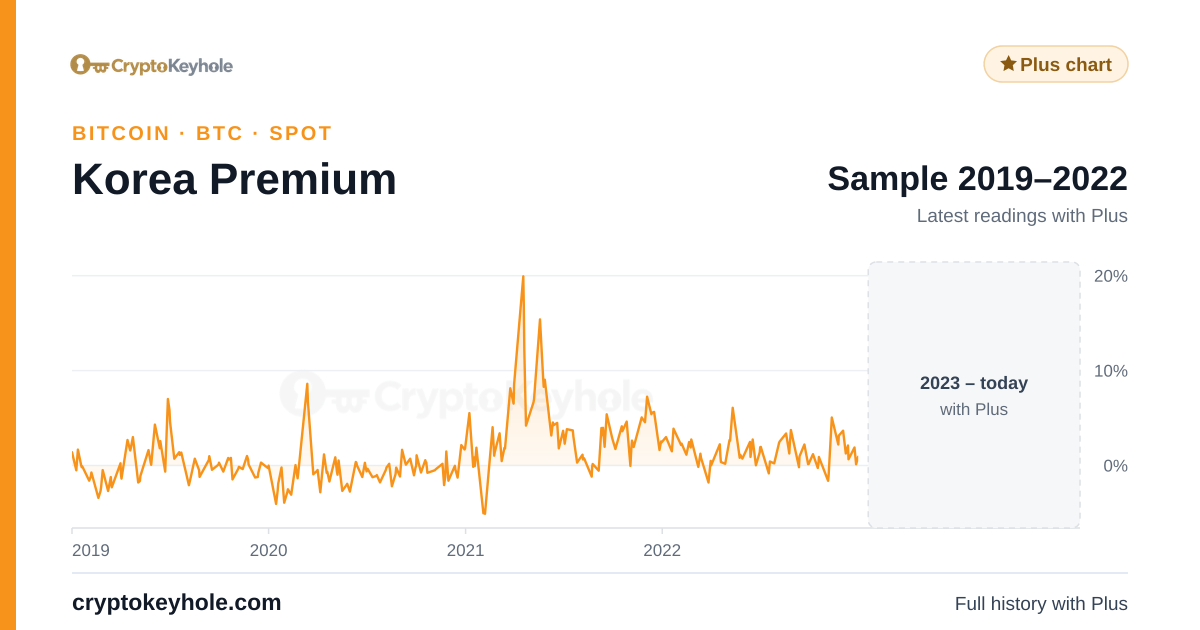
In CryptoKeyhole's daily history, which begins on 14 Aug 2015, Bitcoin's premium peaked at +54.4% on 8 Jan 2018, at the height of the 2017-18 retail mania, and reached +19.9% on 18 Apr 2021 in the 2021 run. Its deepest discount was −5.1% on 3 Feb 2018. Over the past year it has stayed between −3.0% and +4.1%.
Why bitcoin costs more in Korea
Korean exchanges trade crypto against the won, and moving money in and out of Korea is slow: banks cap and check transfers, exchange accounts must be tied to a real-name Korean bank account, and foreign traders are largely kept out. So the arbitrage that keeps prices together elsewhere, buying cheap on one exchange and selling dear on another, works only slowly between Korea and the rest of the world.
When Korean retail buyers pile in faster than that arbitrage can supply coins, the local price rises above the world price; when they sell, it falls below. That is why the premium is watched as a gauge of Korean retail demand: it spiked past 50% in the January 2018 mania and near 20% in spring 2021, and a discount usually marks local selling. Most of the time it sits within a percent or two of zero.
How CryptoKeyhole measures it
For each won market, the premium is 100 × (the hour's close in won ÷ won per US dollar ÷ CryptoKeyhole's own US-dollar index close for the same hour − 1). Upbit and Bithumb are weighted by the won each traded in the hour. The exchange rate is the European Central Bank's daily euro reference rates (won per euro divided by dollars per euro), set at 14:15 CET each business day and used from 16:00 UTC; weekends and holidays carry the last rate. A daily rate leaves the won's moves within a day in the hourly figure, typically a few tenths of a percent, so read the premium over hours and days. Each hour is computed when it closes and appears here about ten minutes later. These are the latest values of our Korea Premium chart.
Quoting these figures? Credit CryptoKeyhole with a link to this page. Prices are Upbit's and Bithumb's published candles; exchange rates are the European Central Bank's.
Questions
What is the kimchi premium today?
What is the kimchi premium?
The gap between what bitcoin costs on South Korea's won exchanges and what it costs everywhere else, in percent. It is called the kimchi premium after Korean food; Korea premium is the same thing.
Is a high kimchi premium bullish or bearish?
It shows strong Korean retail demand, which has come near the end of past rallies as often as at their start: the premium peaked in January 2018 and spring 2021, close to cycle tops. A premium that builds steadily over days says more than a single hour.
Why do traders not arbitrage it away?
They try, but Korea's capital controls make moving money and coins across the border slow and capped, so the gap can stay open for days or weeks when demand is strong.
Which exchanges are included?
Upbit and Bithumb, the two largest won exchanges, weighted by the won each trades in the hour.
Figures on this page come from CryptoKeyhole's own collection of the public market data of the exchanges named on it, and refresh automatically. Nothing here is investment advice.