
Where the nodes reached run
Ask about this page
Our AI analyst answers questions about this page from CryptoKeyhole’s own data and charts. Free with an account.
Asking opens a free account in a few seconds (a username and a password, no email); then the answer appears here.
Who hosts them
The three largest operators host 20% of the nodes reached. A single operator's outage or change of policy would take that many at once.
| Network operator | Share of nodes |
|---|---|
| Hetzner Online GmbH | 10.1% |
| Amazon.com, Inc. | 5.2% |
| Google LLC | 5.0% |
| OVH SAS | 4.0% |
| DigitalOcean, LLC | 3.8% |
| AT&T Enterprises, LLC | 3.2% |
| Comcast Cable Communications, LLC | 3.0% |
| Verizon Business | 2.3% |
| Contabo GmbH | 1.8% |
| IONOS SE | 1.4% |
| Vodafone GmbH | 1.0% |
| Korea Telecom | 0.9% |
| Other networks | 58.3% |
| Not matched to a network | 0.0% |
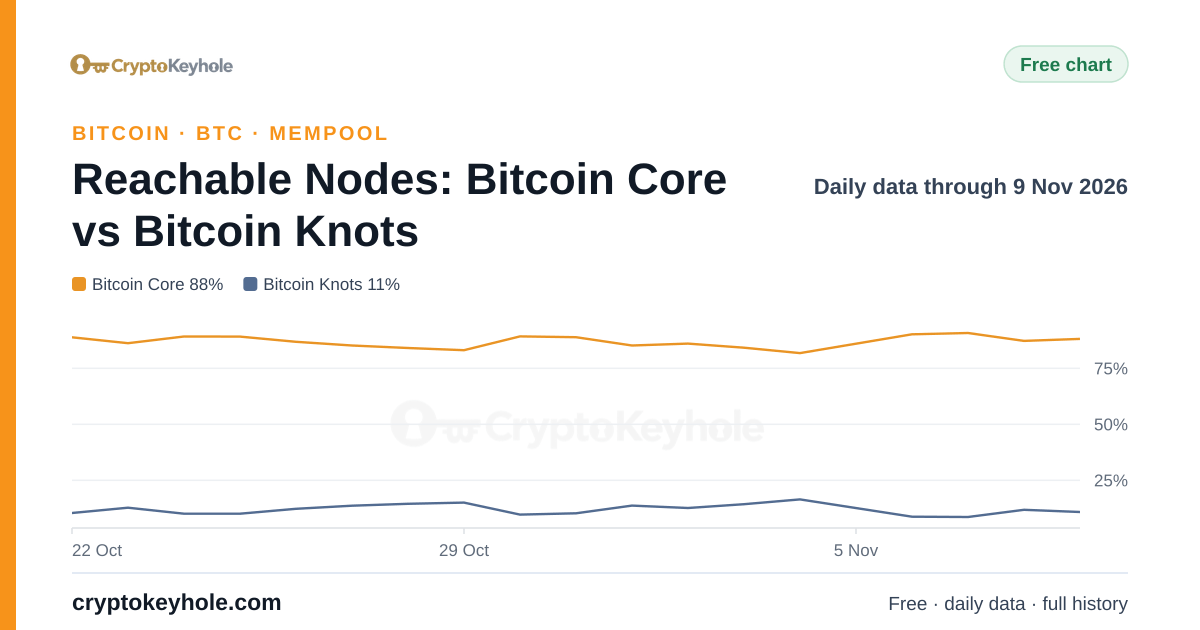
Bitcoin Core against Bitcoin Knots
Bitcoin CoreBitcoin Knots
Other ways nodes connect
How this is counted
The sample. Our crawler connects out to Bitcoin nodes over IPv4, completes the version handshake and hangs up, twice an hour, contacting every node it reached in the previous day. It reads what a node announces about itself: its software and version, service flags and fee filter. That sample is smaller than the network; IPv4-only reach is the main reason other counts run higher, and a snapshot is published only if it reached at least 90% of the sample.
Countries and network operators come from DB-IP's free IP to Country Lite and IP to ASN Lite databases (CC BY 4.0, db-ip.com): each reached address is looked up while it is counted, and only the country and the network are kept. No address is stored, logged or published. A country here is where the network that holds the address is used, which for a VPN or a server rental can differ from where its operator lives.
Software shares use the name and version in each node's handshake, which an operator can change. Bitcoin Knots reports both its own name and the Core version it is built on, and counts as Knots.
Limits. Listening IPv4 nodes only, so nodes behind firewalls, and those reachable only over IPv6, Tor, I2P or CJDNS, are not reached; the addresses announced for those networks are shown as heard, not as reached. The crawler started on 22 October 2026.
Questions
How many Bitcoin nodes are there?
Nobody counts every node, because most do not accept incoming connections. Our crawler reached 1,957 over IPv4 in its latest snapshot; other trackers that also reach IPv6 and Tor list around twenty thousand listening nodes, and estimates of all nodes, listening or not, run far higher.
What is Bitcoin Knots?
A Bitcoin node implementation derived from Bitcoin Core, with its own defaults on which transactions to relay. Its share of nodes is often quoted as a measure of support for stricter relay policies.
Are node locations exact?
No. The country is the one where the network holding an address is used. A node on rented server space counts where the server is.
Does this site keep the addresses of nodes?
No. The crawler holds each address in memory only long enough to contact it and count it, and keeps only totals per snapshot.
Open the node chartsAll free tools
Figures on this page are calculated by CryptoKeyhole from our own Bitcoin node and the price data we collect, and refreshed automatically; estimates say how they are made. Nothing here is investment advice.