
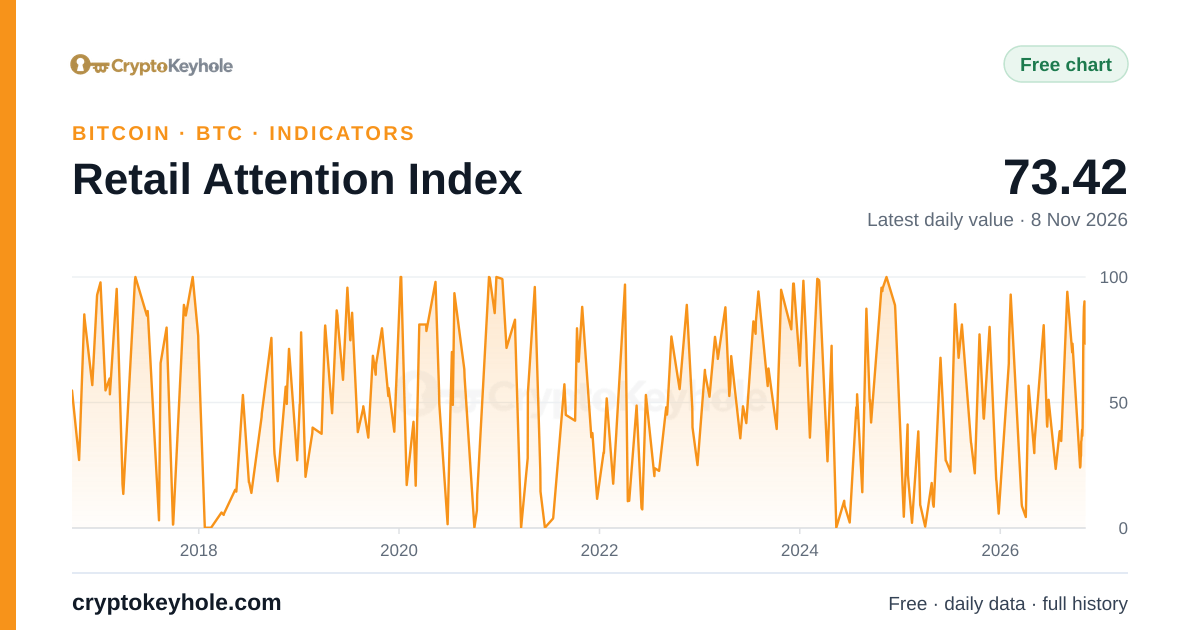
Two years of attention
- Very quiet
- Cooling
- Steady
- Building
- Surging
Ask about this page
Our AI analyst answers questions about this page from CryptoKeyhole’s own data and charts. Free with an account.
Asking opens a free account in a few seconds (a username and a password, no email); then the answer appears here.
Which coins people are looking up
Momentum is the coin’s last 7 days of article views against its last 90; a coin over 1.00× is drawing more readers than usual. Its score places that against its own two years, so a small coin’s spike and Bitcoin’s steady week can be compared. Click a heading to sort.
| Coin | Momentum | Attention score | Views a day, last 7 | Share of attention |
|---|---|---|---|---|
| Official TrumpTRUMP | 1.34× | 8836 a week ago | 720 | 6.9% |
| World Liberty FinancialWLFI | 1.34× | 7566 a week ago | 529 | 5.0% |
| POL (ex-MATIC)POL | 1.24× | 9285 a week ago | 125 | 0.9% |
| LitecoinLTC | 1.23× | 7883 a week ago | 255 | 3.2% |
| The GraphGRT | 1.17× | 7490 a week ago | 19 | 0.2% |
| BitcoinBTC | 1.17× | 8493 a week ago | 6,002 | 46.1% |
| EthereumETH | 1.07× | 8088 a week ago | 1,218 | 8.6% |
| MoneroXMR | 0.99× | 6576 a week ago | 418 | 3.6% |
| AvalancheAVAX | 0.99× | 6741 a week ago | 64 | 0.6% |
| DecentralandMANA | 0.97× | 6840 a week ago | 50 | 0.5% |
| DogecoinDOGE | 0.93× | 6557 a week ago | 492 | 4.1% |
| ToncoinTON | 0.90× | 7149 a week ago | 110 | 1.0% |
| XRPXRP | 0.89× | 5563 a week ago | 305 | 2.5% |
| Axie InfinityAXS | 0.88× | 4092 a week ago | 116 | 1.0% |
| AaveAAVE | 0.82× | 3275 a week ago | 58 | 0.4% |
| BNBBNB | 0.81× | 1767 a week ago | 38 | 0.3% |
| Pyth NetworkPYTH | 0.81× | new | 3 | 0.0% |
| WorldcoinWLD | 0.81× | 4530 a week ago | 158 | 1.3% |
| Ethereum ClassicETC | 0.80× | 25100 a week ago | 46 | 0.4% |
| Bitcoin CashBCH | 0.77× | 2454 a week ago | 99 | 1.1% |
| TezosXTZ | 0.72× | 129 a week ago | 22 | 0.3% |
| UniswapUNI | 0.68× | 1257 a week ago | 82 | 0.7% |
| SuiSUI | 0.68× | new | 3 | 0.0% |
| CardanoADA | 0.67× | 1635 a week ago | 87 | 0.9% |
| Pump.funPUMP | 0.66× | 2821 a week ago | 156 | 1.7% |
| StellarXLM | 0.66× | 1526 a week ago | 53 | 0.6% |
| PancakeSwapCAKE | 0.65× | 2454 a week ago | 17 | 0.1% |
| PolkadotDOT | 0.65× | 68 a week ago | 49 | 0.5% |
| NeoNEO | 0.64× | 45 a week ago | 11 | 0.1% |
| Shiba InuSHIB | 0.64× | 1321 a week ago | 80 | 0.6% |
| CosmosATOM | 0.63× | new | 4 | 0.0% |
| FilecoinFIL | 0.61× | 20 a week ago | 31 | 0.3% |
| AlgorandALGO | 0.60× | 414 a week ago | 24 | 0.3% |
| ChilizCHZ | 0.59× | 172 a week ago | 10 | 0.1% |
| SolanaSOL | 0.58× | 411 a week ago | 330 | 3.1% |
| DashDASH | 0.57× | 718 a week ago | 31 | 0.4% |
| ChainlinkLINK | 0.57× | 23 a week ago | 51 | 0.5% |
| Hedera HashgraphHBAR | 0.55× | 35 a week ago | 20 | 0.2% |
| TRONTRX | 0.46× | 45 a week ago | 228 | 1.5% |
| NearNEAR | 0.21× | 08 a week ago | 27 | 0.4% |
Plus adds the score history of the largest coins, the two averages behind the index, and this table as a CSV file.
Compare plansHow the index is built
Each day we take the views of the Wikipedia article of every coin CryptoKeyhole counts, in the ten editions with the most readers, with crawlers and automated agents excluded. We add the coins whose article has the whole last 90 days, so a coin joining never makes a jump.
Momentum is the average views of the last 7 days over the average of the last 90. The index is that momentum’s percentile among the last 730 days’ readings (at least 365): the share of those days whose momentum was at or below today’s, times 100. Each coin’s score is the same calculation on its own article.
A day appears once Wikimedia has published it for every coin, about a day after it ends, so a reading never moves afterwards.
Coverage and limits
- It reads Wikipedia only for now. Coinbase’s App Store rank is shown beside the index, not in it; it joins as a second component once it has 90 days of its own history to be scored against (hourly collection began on 8 November 2026).
- It measures change, not size: after a burst of attention the index falls even while readership stays high, because the last 7 days are set against a busy 90.
- Article views are a proxy for curiosity. They do not show who is reading, or whether they go on to buy; nothing here is about any individual.
- A coin needs a Wikipedia article about itself: coins without one are not counted.
Questions
Is retail interest in crypto back?
What is the Retail Attention Index?
A daily 0 to 100 score of how fast public curiosity about crypto is changing, built from how many people read the Wikipedia articles of the coins we count. It answers whether newcomers are arriving without using any social-media data.
Why Wikipedia?
Reading a coin’s article is what people do when they hear about it for the first time, before they open an account. Wikimedia publishes the counts openly, day by day and back to July 2015, with crawlers separated out.
How often does it update?
Once a day, as soon as Wikimedia has published the day for every coin, usually within a day of it ending. The page rechecks every hour.
Open the chartGet the APIAll free tools
Scores are CryptoKeyhole’s own, computed from Wikimedia’s public page-view data; they measure curiosity, not its reasons.